
Severna Park Filmmaker Makes Documentary About Asian
Severna Park Voice | Article by Alyson Kay
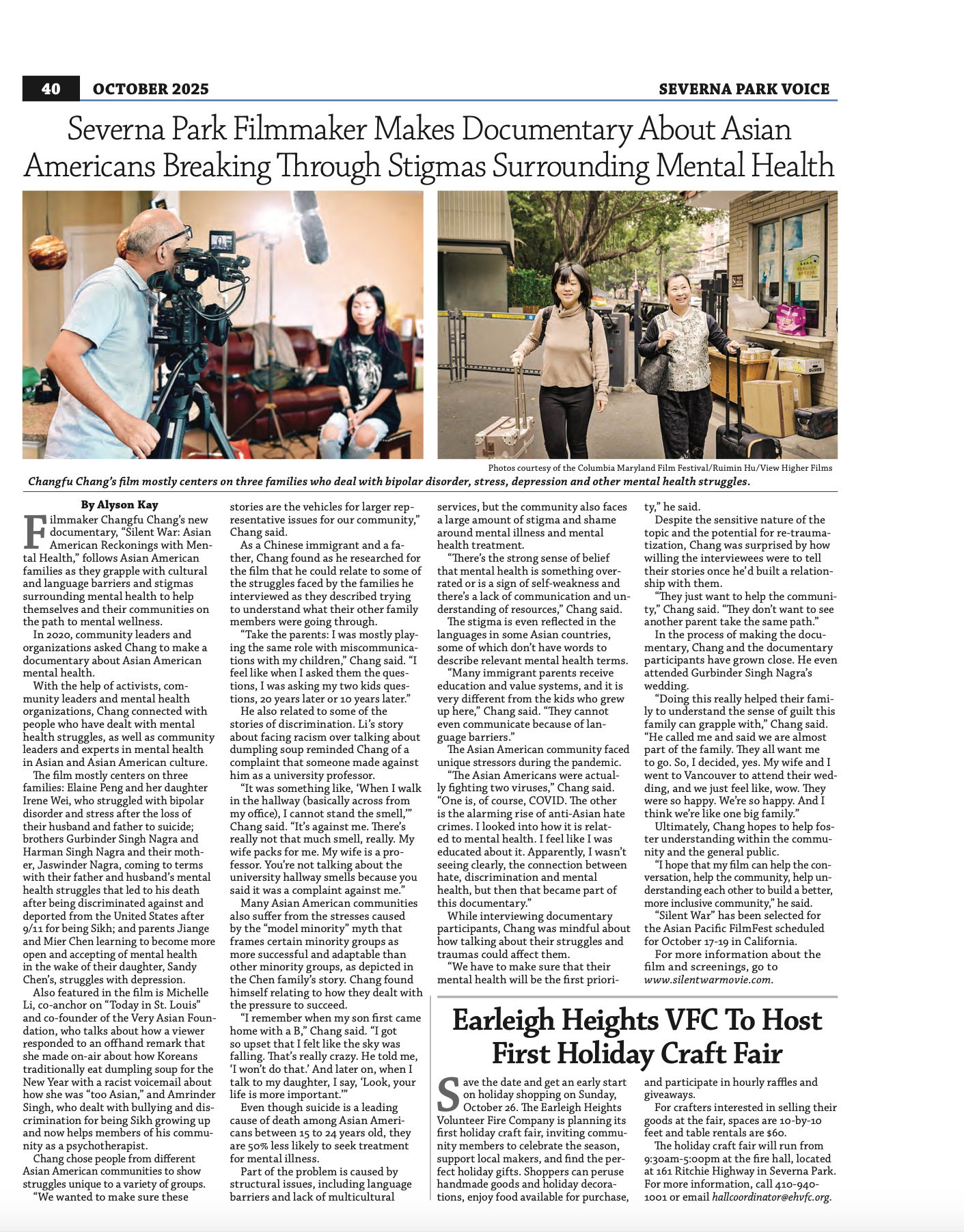
Filmmaker Changfu Chang’s new documentary, Silent War: Asian American Reckonings with Mental Health, follows Asian American families as they grapple with cultural and language barriers and stigmas surrounding mental health to help themselves and their communities on the path to mental wellness.
In 2020, community leaders and organizations asked Chang to make a documentary about Asian American mental health.
With the help of activists, community leaders and mental health organizations, Chang connected with people who have dealt with mental health struggles, as well as community leaders and experts in mental health in Asian and Asian American culture.
The film mostly centers on three families: Elaine Peng and her daughter Irene Wei, who struggled with bipolar disorder and stress after the loss of their husband and father to suicide; brothers Gurbinder Singh Nagra and Harman Singh Nagra and their mother, Jaswinder Nagra, coming to terms with their father and husband’s mental health struggles that led to his death after being discriminated against and deported from the United States after 9/11 for being Sikh; and parents Jiange and Mier Chen learning to become more open and accepting of mental health in the wake of their daughter, Sandy Chen’s, struggles with depression.
Also featured in the film is Michelle Li, co-anchor on “Today in St. Louis” and co-founder of the Very Asian Foundation, who talks about how a viewer responded to an offhand remark that she made on-air about how Koreans traditionally eat dumpling soup for the New Year with a racist voicemail about how she was “too Asian,” and Amrinder Singh, who dealt with bullying and discrimination for being Sikh growing up and now helps members of his community as a psychotherapist.
Chang chose people from different Asian American communities to show struggles unique to a variety of groups.
“We wanted to make sure these stories are the vehicles for larger representative issues for our community,” Chang said.
As a Chinese immigrant and a father, Chang found as he researched for the film that he could relate to some of the struggles faced by the families he interviewed as they described trying to understand what their other family members were going through.
“Take the parents: I was mostly playing the same role with miscommunications with my children,” Chang said. “I feel like when I asked them the questions, I was asking my two kids questions, 20 years later or 10 years later.”
He also related to some of the stories of discrimination. Li’s story about facing racism over talking about dumpling soup reminded Chang of a complaint that someone made against him as a university professor.
“It was something like, ‘When I walk in the hallway (basically across from my office), I cannot stand the smell,’” Chang said. “It’s against me. There’s really not that much smell, really. My wife packs for me. My wife is a professor. You’re not talking about the university hallway smells because you said it was a complaint against me.”
Many Asian American communities also suffer from the stresses caused by the “model minority” myth that frames certain minority groups as more successful and adaptable than other minority groups, as depicted in the Chen family’s story. Chang found himself relating to how they dealt with the pressure to succeed.
“I remember when my son first came home with a B,” Chang said. “I got so upset that I felt like the sky was falling. That’s really crazy. He told me, ‘I won’t do that.’ And later on, when I talk to my daughter, I say, ‘Look, your life is more important.’”
Even though suicide is a leading cause of death among Asian Americans between 15 to 24 years old, they are 50% less likely to seek treatment for mental illness.
Part of the problem is caused by structural issues, including language barriers and lack of multicultural services, but the community also faces a large amount of stigma and shame around mental illness and mental health treatment.
“There’s the strong sense of belief that mental health is something overrated or is a sign of self-weakness and there’s a lack of communication and understanding of resources,” Chang said.
The stigma is even reflected in the languages in some Asian countries, some of which don’t have words to describe relevant mental health terms.
“Many immigrant parents receive education and value systems, and it is very different from the kids who grew up here,” Chang said. “They cannot even communicate because of language barriers.”
The Asian American community faced unique stressors during the pandemic. “The Asian Americans were actually fighting two viruses,” Chang said. “One is, of course, COVID. The other is the alarming rise of anti-Asian hate crimes. I looked into how it is related to mental health. I feel like I was educated about it. Apparently, I wasn’t seeing clearly, the connection between hate, discrimination and mental health, but then that became part of this documentary.”
While interviewing documentary participants, Chang was mindful about how talking about their struggles and traumas could affect them.
“We have to make sure that their mental health will be the first priority,” he said.
Despite the sensitive nature of the topic and the potential for retraumatization, Chang was surprised by how willing the interviewees were to tell their stories once he’d built a relationship with them.
“They just want to help the community,” Chang said. “They don’t want to see another parent take the same path.”
In the process of making the documentary, Chang and the documentary participants have grown close. He even attended Gurbinder Singh Nagra’s wedding.
“Doing this really helped their family to understand the sense of guilt this family can grapple with,” Chang said. “He called me and said we are almost part of the family. They all want me
to go. So, I decided, yes. My wife and I went to Vancouver to attend their wedding, and we just feel like, wow. They were so happy. We’re so happy. And I think we’re like one big family.”
Ultimately, Chang hopes to help foster understanding within the community and the general public.
“I hope that my film can help the conversation, help the community, help understanding each other to build a better, more inclusive community,” he said.
Silent War has been selected for the Asian Pacific FilmFest scheduled for October 17-19 in California.
For more information about the film and screenings, go to www.silentwarmovie.com.
